

Introduction
Custom CNC turning component procurement engineers frequently face a puzzling situation where quotations for the same part from various providers may differ from one another by 50% to 80%. This incredible CNC turning cost variance is not only unpredictable but also results in additional costs of 15-20% within the project lifetime due to extra fees that could have been avoided.
This situation is caused by the black-box nature of standard quotation procedures. It means that no information is provided about the factors that influence actual cost levels, including real machining time, material yield, tool management processes, and costs related to quality assurance services. Cost comparisons based on prices do not reflect any value in this case. This article offers an insight into the technical analysis that can be applied to CNC turning quotations and their cost components.
Why Are There Such Wide Swings in a “CNC Turning Quote”?
A 65% swing in CNC turning quotes isn’t necessarily about overpricing. In many cases, it reflects differences in fundamental assumptions about the technology that goes into CNC turning and the operations necessary to produce a product. These differences arise because the suppliers are modeling the underlying four pillars of manufacturing costs differently and are doing so using factors that aren’t reflected in the price itself.
H3: 1. Material Modeling: Theory vs. Actual Weight Optimization
The first key area of variance involves calculating the cost of materials. Supplier A can base its quotations on the theoretical weight of the raw bar stock, whereas Supplier B utilizes advanced nesting technology that allows for higher material yields from the same raw bar stock. Supplier B’s efficiency could be such that it achieves an 85% yield compared to Supplier A’s 65%, resulting in a 20% difference in material yield alone.
Time Puzzle: Ideal Parameters vs. Realistic Capability Driven Speeds
Time estimates vary widely between suppliers. While some will utilize standard handbooks speeds and feeds, others will base their estimate on parameters tuned over thousands of pieces done on their exact machinery. A newer machine, perhaps even slightly more rigid, allows a supplier to work 40 percent faster than a standard lathe, cutting down the time taken immensely. Such a discrepancy between realistic machining efficiencies will result in tremendous differences in overheads and labor charges embedded in the quotation.
Tooling Tactics: Allocation of Cost and Tool Life Cycle
Tooling charge is a key variable. One will charge a fixed amount as tooling charge, while the other will use an advanced cost per piece calculation model based on the known life of the tool used on your particular material and feature. Such a system allocates the cost of costly specialty tools across all parts produced, resulting in a more precise, though sometimes more expensive, line item in the CNC turning prices.
H3: 4. The Quality Premium: Assurance Construction Versus Error Detection
Lastly, there will be hidden or transparent costs associated with quality assurance. A machining shop running with a rudimentary system of inspections will benefit from reduced costs. A facility that adheres to IATF 16949 or AS9100D standards will incur costs in the implementation of statistical process control, probing in-process operations, traceability of materials, and document management. While ensuring quality, such a move also drives up costs, which should be considered according to manufacturing economics experts.
H2: Going Beyond the Numbers: What Makes “CNC Turning Pricing” Transparent?
Real transparency of cost and true industrial clarity starts with a detailed quote. A transparent CNC turning pricing system is one that does not conceal its cost behind a mere number but breaks it down to allow buyers to make an analysis of technical value.
H3: 1. The Foundation: Materials, Machine Time, Tooling
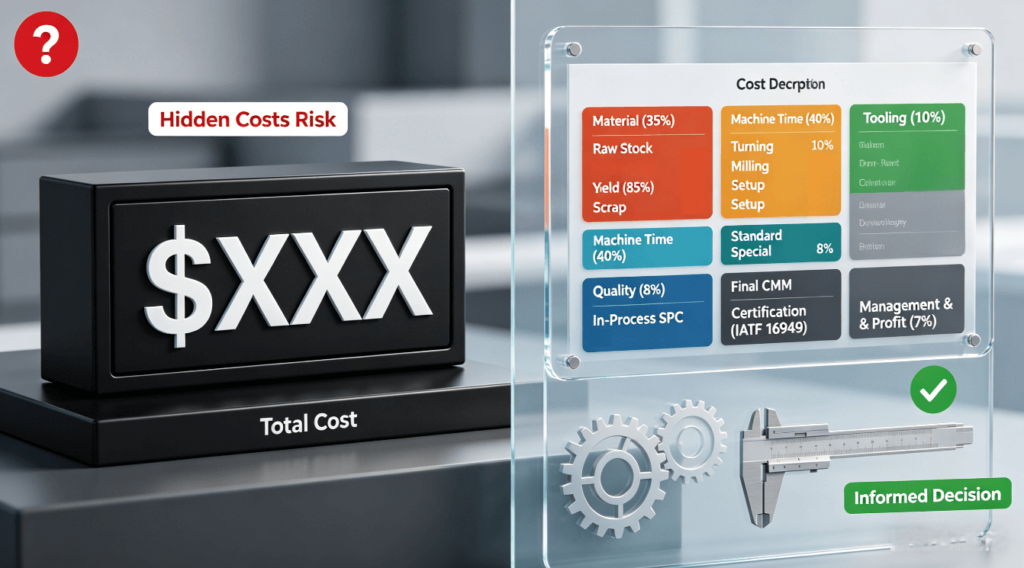
An open-book costing system begins with identifying key direct expenses. Material Cost would require noting the type of metal used, its grade, and expected efficiency percentage. Machining Cost will have to itemize each machine function (turning, milling, threading, etc.) with corresponding machining times and respective rates per minute. Tooling & Fixture Costs would have to differentiate between normal wear and tear and custom jigs or fixtures necessary for the production. This will shed light on the largest part of your budget.
H3: 2. The Extras: Finishing, Quality Control, and Other Add-Ons
In addition to the main machining services, there will be some value adds involved, such as Secondary Processing that may consist of anodizing, heat treating, plating. Also critical will be Quality Assurance Costs, which include FAIR inspection, material certification, or even CMM inspection if you want additional assurance that your workpiece is perfect. Last but not least will be your Management & Profit.
H3: 3. From Data to Insights: Using the Quote as a Diagnostic Tool
Now that the quote is laid out in such an organized fashion, it becomes a manufacturing insight tool rather than simply a financial one. One can readily determine whether the high cost results from materials, difficult machining processes, or a highly involved inspection process. It becomes possible for one to ask relevant questions: “Are there any materials we could use that would be easier to machine?” or “Does this tolerance matter?” In order to learn more about this analytical process, one can consider this CNC turning cost analysis guide.
H2: How Can “Precision Manufacturing” Certifications Such as ISO and IATF Benefit Your “CNC Turning Budget”?
While it is true that ISO 9001, IATF 16949, and AS9100D certifications have traditionally been considered an expense, they are really just a preventative system designed to protect and optimize the overall CNC turning budget by avoiding much higher expenses related to mistakes.
- The Cost of Prevention: Building Quality In: A certified precision manufacturing system comes at a price: thorough vendor audits for raw material quality, accurate machine calibration, ongoing employee training, and detailed process documentation. These are all expenses in preventing defects. Although they increase the cost of the initial quote, they represent an economic advantage over the “check-and-scrub” approach, which causes waste, rework, and downtime, potentially inflating parts costs by a factor of ten.
- Risk Management as Financial Protection: Auto industry regulations such as IATF 16949 mandate APQP and PPAP. This well-organized pre-production risk assessment acts as an assurance that the manufacturing process will be ready and stable when mass production starts. The investment in this practice serves as a protective measure against expensive disasters that could lead to recalls, warranty issues, and loss of brand imagethese are the risks that easily outweigh the cost of obtaining certification.
- The Value of Traceability: When the system is certified, it gives complete digital traceability, where every part is traceable to the heat number of the material used, the program used in the machine, and the inspection report. It goes beyond the need for auditing; if there are any issues, the system makes it easy to carry out a root cause analysis, thereby saving time and money from containment actions. Traceability is thus not an option but a necessity when it comes to project stability and cost of ownership.
H2: What is the True Cost of Rush Orders? A “Production Economics” View
In terms of production economics, rush orders are interruptions that have been caused in a perfectly balanced system. The cost that is paid is not extra profit but rather covers the loss of efficiency that is inherent in such a decision.
H3: 1. Domino Effect in Production Planning
The inclusion of a rush order requires changing the schedule of the existing jobs, thereby resulting in machine changeover costs and delays for other customers. It disrupts production scheduling such that the optimal process cannot be achieved and results in a lower OEE. This disruption entails costs that can be calculated in terms of a premium charge of 15-25% for the compression of 30% lead time, based on industry benchmarking for capacity utilization.
H3: 2. Compromising Efficiency and Quality for Urgency
Ordinary production batches include periods of process optimization, which means the implementation of optimal parameters for the process. Rush orders might result in the necessity to use aggressive parameters that increase wear on the equipment or might exclude some secondary optimization procedures. The CNC turning cost will rise since the process will operate under conditions of increased efficiency risk.
H3: 3. Compression in Supply Chain and Logistics
Rushed schedules can cause compression throughout the entire supply chain. It may mean that airfreight needs to be utilized to move the material to the factory for processing. Other processes such as expedited surface treatments and overnight deliveries may also add to the costs of doing business. However, these are not hidden charges. Rather, they are explicit charges associated with compressed lead times, and should be spelled out by a good supplier in a rush CNC turning RFQ.
H2: What Is the Forensic Approach to Doing a CNC Turning RFQ Analysis for Maximum Value?
Shifting from being a passive price taker to becoming an active manager of value requires the use of a forensic approach to analyzing each CNC turning RFQ. The approach entails the use of forensic tools in breaking down the quotation and assessing its assumptions.
H3: 1. Step One: Specification Compliance and Fine-Level Decomposition
Ensure that all the bids quoted by various suppliers comply with the same specifications including: the revised drawing number, material certification, and inspection process. Once all the above is done, break down each bid into individual items and analyze each item at length. Scrutinize the material cost: what is the expected yield? Examine the machine hours: can you use another operation route? The above analysis uncovers the engineering logic embedded in each cost.
H3: 2. Step Two: Assessment of Collaboration and Risk Management
The best quotation will include some unasked-for DFM advice — how to cut costs without sacrificing functionality. That shows a collaborative spirit. In addition, examine the supplier’s risk-mitigation strategies: Do they have a backup plan in case there isn’t enough capacity? How do they handle quality escapes? The answers will give you an idea of how mature they are as an organization.
H3: 3. Step Three: Synthesis of Data Leading to a Strategic Choice
At this point, synthesis of data concerning price, capability, and risks is undertaken. While the cheapest option carries the greatest potential delays or product defects, the aim is to make an informed choice based on the best total value available from a supplier. In most cases, this involves selecting companies that have CNC turning parts manufacturer built into their corporate DNA and therefore, offer you a production process optimized by efficiency.
H2: Case Study: Cutting 34% Cost Through Collaborative “Cost Decoding”
It can be seen from practical experience that theoretical models and frameworks are effective. A practical example was the manufacture of a critical part, the C45 steel steering knuckle within the automotive industry. With a massive 65% quote difference, the issue could only be solved through collaborative cost decoding.
H3: 1. The Problem: Expensive, Impractical, and High-Risk
Four setups using various machines made it difficult to achieve positional accuracy (±0.1mm), with the cost per piece being too high at 140 RMB. The complexity of the process increased chances of inaccuracies, making it incompatible with the client’s high-output production facility due to cost and logistical issues in manufacturing these customized CNC turning parts.
H3: 2. The Collaborative Approach: Innovation in Processes and Tools
The engineers at the company overhauled the whole manufacturing process of their product. They created a manufacturing process involving a five-axis turning machine that would machine all the critical features in one setting. This is possible because they designed a multi-purpose tool holder that can do the jobs of drilling, boring, and threading in one setting only. This will avoid any alignment problems. In addition to this, the engineers optimized the lean manufacturing process such that the tool change would coincide with the handling of the workpieces.
H3: 3. The Measurable Output: Performance and Savings
The outcome was remarkable: per-unit cost fell by 34% to 92 RMB, while geometrical precision increased by 60%. The redesigned process delivered 99.5% of products in time, providing a seamless production ramp-up. The annual savings of 2.8 million RMB were ploughed back into research and development by the customer. It is evident that real cost reduction can only be realized through genuine process transformation and cross-functional engineering collaboration rather than merely negotiating with suppliers.
H2: Conclusion
Expert knowledge of CNC turning costs requires a paradigm shift from mere surface-level price comparison to profound value assessment. By unraveling the underlying technology-based reasons for quoting prices, comprehending the premium value of accredited quality management systems, and employing a forensic approach to RFQs’ evaluation, both purchasing specialists and engineers can make informed decisions that guarantee sustainable engineering efficiency and robustness of the supply chain.
H2: FAQs
Q: What are some examples of hidden costs in CNC turning quoting?
A: Some examples of common hidden costs are NRE charges, tooling/fixtures, and detailed inspection requirements. These fees can add up to 8-15% or more to your base quote. If the company is being fully transparent, then these costs will be broken out instead of buried in the overhead costs.
Q: How can one effectively compare prices among CNC turning services providers?
A: It’s crucial to have each bidder offer you a quote based on the same drawing, material, and specifications. Next, one should focus on the detailed line items: material price per unit, machine time for each operation, and the tooling fee. It’s important to study the pricing structure: high machine costs with lower time can signal efficiency. Comparison of value should be aimed at, not price.
Q: Would it be reasonable to pay extra for an ISO 16949 and AS9100D-certified supplier?
A: If you require automotive, aviation, or medical components, this would be a wise decision. These certifications involve the implementation of strict processes and risk management, which eliminate risks of errors and downtime. Such a decision is well-invested into protecting the overall total cost of ownership.
Q: What is the reason that cost per piece is reduced when there are more parts in CNC turning?
A: When the fixed cost is shared according to the size of the order. So when the order is 10 pieces, the setup cost is divided by 10 however 1000 pieces would split the same setup cost among 1000 equal parts. A large volume will also permit the production process to be simplified and thus made more efficient.
Q: What data should I provide in order to receive an accurate quote on CNC turning quickly?
A: All necessary documents must be provided, including detailed technical specifications and drawings (PDF with GD&T); solid modeling, STEP, IGES, CAD models; materials and certificates; anticipated or annual production volume; required lead time; post-production processing details.
H3: Author Bio
The author is an expert specializing in precision manufacturing and supply chain cost analysis, possessing deep expertise in deconstructing the economics of manufacturing to enhance transparency and drive optimization. Their team, LS Manufacturing, is dedicated to delivering actionable insights, aiming to transform the procurement function from a mere “cost center” into a pivotal source for building competitive advantage and ensuring predictable project execution.