

Introduction
The creation of a working prototype from a groundbreaking idea is one of the key steps for successful product development in hardware startups and research and development teams. Yet, this stage proves to be extremely problematic in terms of budget and timing, holding up the entire product development process due to high costs and constant delays. And while some may blame the initial concept for this failure, most problems stem from a poor grasp of the process. Inefficiencies come in the form of non-manufacturable designs, wrong materials, and poorly chosen rapid prototyping CNC machining companies, resulting in wasted time and effort. Below is an extensive overview of the whole process of CNC machining prototyping service, helping entrepreneurs learn how to manage costs, optimize their designs, choose technologies and vendors efficiently.
How to Accurately Control the Cost of Prototype CNC Machining and Avoid Budget Overruns?
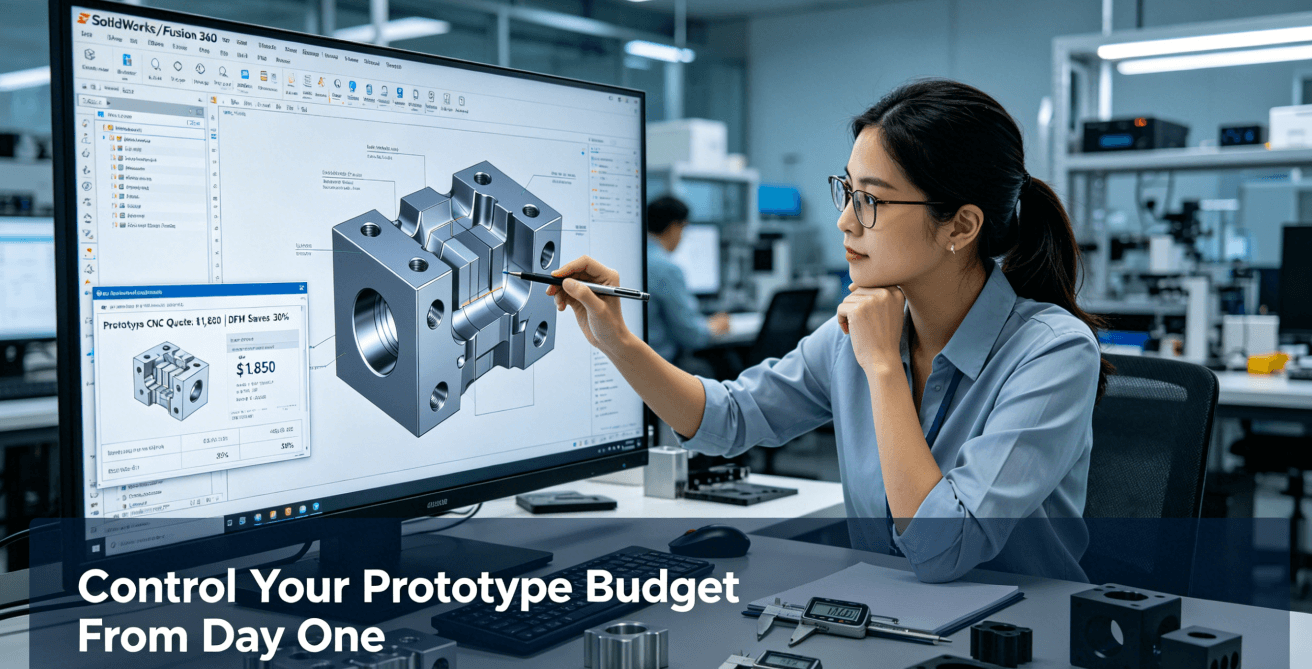
Acquiring a clear prototype CNC machining quote is the initial step to ensure cost control. The quote is generally determined by six fundamental parameters: the material, machining time, complexity, tolerances, post-processing, and quantities. Material acts as the base cost component; for example, stainless steel is much costlier and difficult to machine compared to aluminum.The machining time is directly proportional to the complexity; deep cavities, micrometers of detail, and intricate shapes will lead to increased programming and machining times. Smaller tolerances of ±0.025 mm need high-precision equipment, slower processing rates, and stringent testing, leading to exponential costs. In addition, post-processing operations such as sandblasting or anodization and the principle behind cost sharing among one-off or small-lot quantities should be elucidated.
The best way to achieve good budget control is through conducting a DFM study with a manufacturing industry services firm prior to finalizing the design. The experience of the firm will be able to point out any problems that might arise during the manufacturing process. Some examples include advising on loose tolerance for non-critical areas, designing hard-to-fix parts, and selecting better machining materials with comparable properties. This type of cooperation will normally eliminate 20 to 40 percent of any extra expenses.
At the Design Stage, What Optimizations Can Significantly Improve Prototype Manufacturability and Reliability?
Adopting design for manufacturability techniques at the point of origin improves the chances of successful prototypes, cuts down on lead times, and decreases the overall expenses. This is essential in making excellent custom machined parts.
Applying Design for Manufacturability Rules
Using design for manufacturability techniques is essential when it comes to making reliable custom machined parts. As far as making metal parts is concerned, there should not be any deep cavities, and the use of fillets is important. As for the CNC plastic machining prototype, the goal should be to manage stress and heat.
- Design Rules for Metal Parts
Core principles include limiting cavity depth, unifying hole sizes to minimize tool changes, and incorporating draft angles and standard fillet radii to ensure clean, cost-effective machining.
- Design Rules for Plastic Parts
Designs must counteract plastic’s low stiffness and thermal sensitivity. Use uniform walls, add corner fillets to prevent stress concentration, and employ ribs instead of thick sections to prevent warping.
Utilizing Expert Analysis and Resources
Independent of the chosen material, an unbiased DFM report provided by the manufacturer can be extremely valuable in detecting any major flaws in design prior to production. A thorough guide on this topic would definitely be Prototype CNC Machining Guide.
Facing Different Needs, How to Choose the Most Suitable Rapid Prototyping Technology?
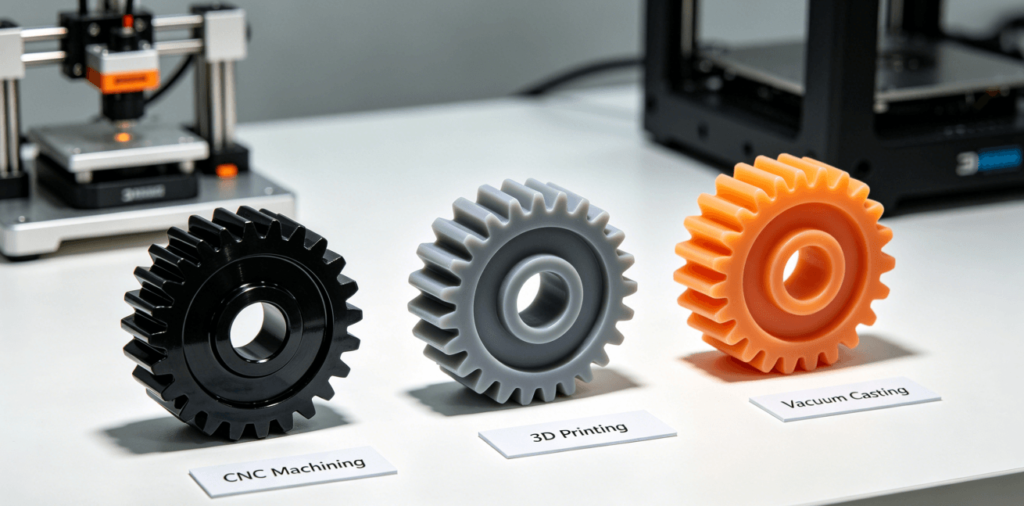
When it comes to prototype manufacturing, the selection of the correct technology is essential because it influences the effectiveness of the prototype validation process. Rapid Prototyping CNC Machining, 3D Printing, and Vacuum Casting are just a few examples of the many technologies used nowadays, each having its advantages and suitable applications.
Comparing Mainstream Prototyping Technologies
Process selection is very important in prototype fabrication. One of the most commonly used processes is rapid prototyping CNC machining, which is known for its precision and realistic properties.
- The Strengths of CNC Machining
This subtractive process creates parts from solid blocks, yielding properties and finishes nearly identical to production parts, which is essential for performance-critical prototypes.
- The Niche for 3D Printing & Molding
Conversely, 3D printing excels at ultra-fast iteration of highly complex geometries. Vacuum casting is optimal for small batches of appearance models or flexible components, though with generally lower strength and precision than CNC.
Implementing a Fusion Strategy
In the case of complicated goods such as electronics, a single technology may not be enough. A top-tier CNC machining prototype service would provide you with a comprehensive solution. A popular method involves using a CNC machined aluminum housing for accuracy and 3D printed mounts internally. This innovative process is referred to as rapid electronic prototyping.
What Key Capabilities Should Be Evaluated When Assessing a Prototype CNC Machining Service Provider?
Choosing a CNC machining prototype manufacturing service that is dependable is very important for your project’s success. The following five things need to be taken into account: Engineering Support: Are they capable of providing valuable DFM feedback at an early stage? Equipment and Processing Capability: Do they have various types of CNC machine capabilities, such as 3-axis or 5-axis machining capabilities to accommodate different levels of difficulty of the work pieces? Quality Control Capability: Do they have sufficient quality control tools, such as CMM and 3D scanning capability?Supply Chain Capability: Are their material inventories dependable and stable?
International quality certifications (such as ISO 9001, IATF 16949, AS9100D) go beyond mere recognition. Instead, they are a testament to a culture of standardized procedures and continuous improvements. This is particularly important in the production of prototype models in fields such as medicine, automobiles, and aeronautics. For instance, during a scenario where the supplier was responsible for the manufacture of propellers used by drones, the firm capitalized on the numerous certifications that they had as well as the First Article Inspection to have the prototyped propellers dynamically balanced at the first time, without any hitches during the test resulting from issues in the prototypes. In this case, the emphasis should be on selecting suppliers like JS Precision that have multiple certifications like ISO 9001:2015, IATF 16949, and AS9100D.
How to Manage a Prototype Manufacturing Project to Ensure On-Time Delivery and Meet Quality Expectations?
Some active methods of Effective Project Management for CNC Machining of Prototypes include: Firstly, it is very important to provide full technical information since the beginning to help avoid the risks of misinterpretation and mistakes. Secondly, it is a good idea to mutually decide on the time that is feasible and realistic including the major milestones (design freeze, design for manufacturing approval, milling completion, and delivery date), and asking the partner to report progress regularly (daily/weekly). Communication is the most important factor in project implementation. Consider your vendor as a co-engineer and talk regularly throughout the entire process. This way, if there arise any problems, they can be sorted out most efficiently. Lastly, define the acceptance criteria of the product and issue the relevant quality documents (FAIR). That can help you ensure that the item you get is not only punctual but also meets the specifications.
Conclusion
Prototype manufacture is far from mere drawing-to-part process; it is a system engineering task that includes cost engineering, design collaboration, technology choice, and logistics. By following the above-mentioned tactics in a systematic fashion, R&D groups can substantially lower risks associated with projects, guaranteeing timely, budget-compliant, and high-quality delivery of prototypes that are ready for further product development.
H2:Author Bio
This article was written by a precision manufacturing expert with over 15 years of experience, specializing in providing solutions from rapid prototyping to mass production for global hardware innovation companies. The insights are derived from hands-on experience assisting numerous teams in transforming complex designs into high-quality, functional manufactured parts.
FAQs
Q1: In prototype CNC machining, what is the biggest cost driver?
A: Apart from the material itself, the part’s geometric complexity is the primary cost driver. Complex surfaces, deep holes, and demanding tolerances significantly increase programming and machine time. Early DFM optimization is the most effective method for cost control.
Q2: How to prevent plastic models from deforming after CNC machining?
A: The main factor here is managing the heat produced during machining. You should use sharp and specialized cutters, increase spindle speeds but decrease feed rates, and use efficient cooling systems. In terms of design, avoid sharp internal corners and try to keep the wall thickness at 1-3 mm.
Q3: Is CNC machining still a viable option for producing small-batch (50-100 pieces) prototypes?
A: Absolutely. Small batches, compared to a single piece, mean that you can spread the cost of fixtures and programming time over multiple units, which usually brings the unit cost down by 20-40%. CNC machining still stands out when it comes to material properties and precision consistency especially at these volumes.
Q4: How long does it usually take to get prototype services in a rush?
A: Based on the level of complexity, by intensifying the work, parts with simple to moderate complexity can be ready in 24 hours to 5 business days. This time frame is achieved through reserving dedicated capacity and performing operations in parallel however one should consider how the extra cost affects the overall project budget.
Q5: If the received prototype part has slight dimensional deviations, how should it be handled?
A: Immediately contact the project manager, providing a detailed inspection report. A responsible manufacturer will initiate a root cause analysis and typically commit to free rework or remanufacturing to ensure the part fully meets specification requirements.